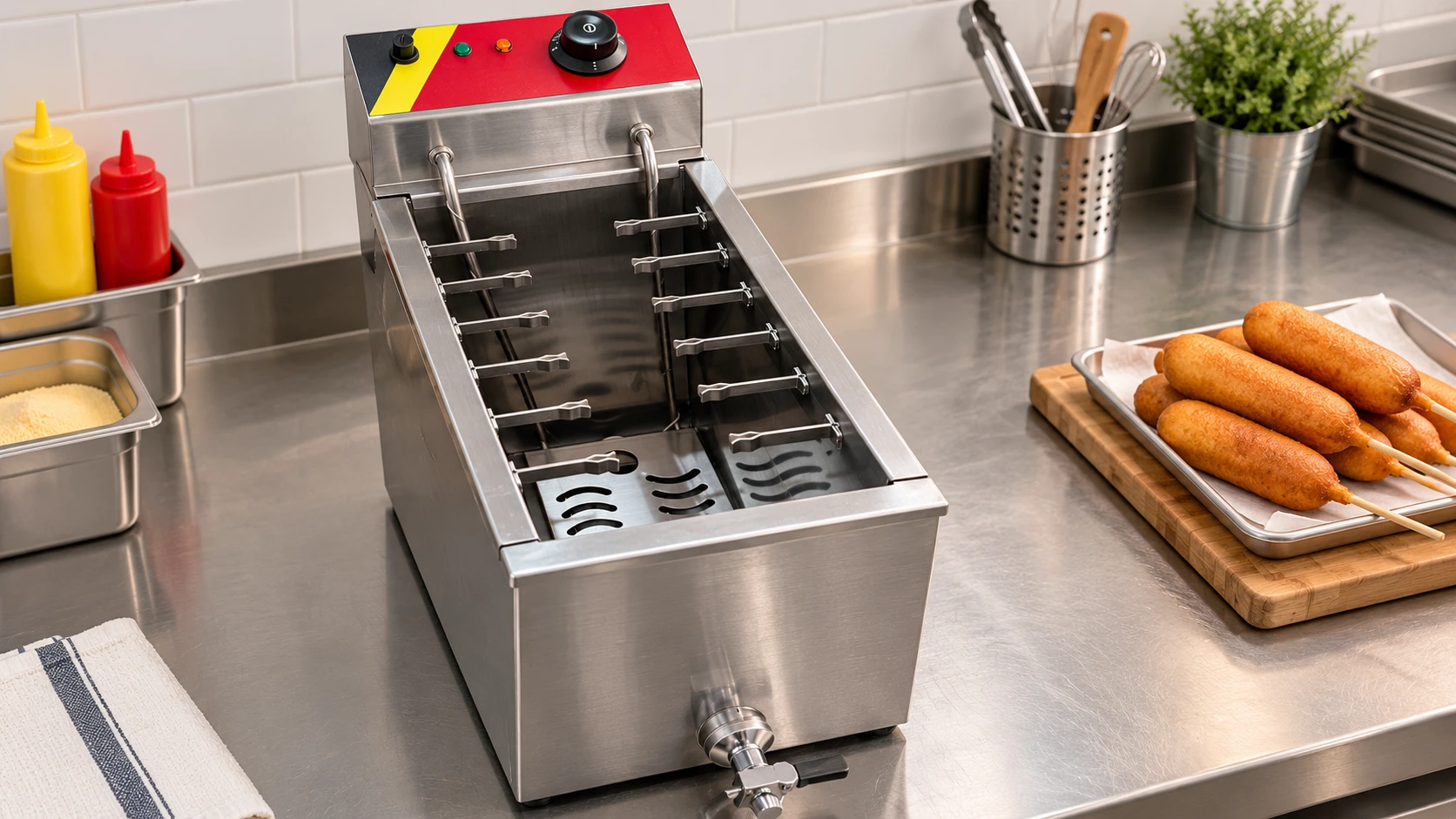
What is a 25-liter corn dog fryer?Why "25 liters" refers to oil tank capacity rather than production capacity
This product belongs to the corn dog fryer category within food processing equipment, with product number 1600492472848, and is used for food ingredient handling, processing, or commercial catering production. The "25 liters" in the name describes the amount of oil the tank can hold, which is a structural parameter of the equipment and has no direct conversion relationship with how many corn dogs can be fried per hour.
Definition of oil tank capacity: what exactly does 25 liters mean
Oil tank capacity answers "how much oil this fryer holds," not "how much output this fryer produces per hour." It affects the space available for ingredients per batch, the difficulty of recovering oil temperature after the impact of loading ingredients, and the baseline for oil changes and oil consumption. With the same 25-liter oil tank, frying frozen corn dogs versus pre-thawed corn dogs, with different individual weights and sizes and different loading intervals, will result in noticeably different actual output rhythms.
Therefore, reading 25 liters as "25 liters/hour" or "25 kilograms per hour" mistakes a unit of volume for a unit of time.
What selection misjudgments arise from treating volume as capacity?
The most common misjudgments fall into three categories:
- Working backward from "25 liters = 25 liters/hour" to plan production schedules: actual capacity depends on the weight per piece, oil temperature setting, reheating speed, and operating pace; when these conditions are unclear, any capacity estimate is only an approximation.
- Directly comparing different equipment by volume: two machines both with 25-liter oil tanks may differ considerably in continuous output capability due to differences in heating power, temperature control method, and tank structure; looking only at the liter count will lead to the wrong choice.
- Ignoring site and supporting conditions: A 25-liter oil tank corresponds to a certain equipment volume, power supply requirements, and exhaust needs. If you determine the capacity first and only then discover that the site does not match, the rework cost is high.
To determine whether this equipment is suitable for your scenario, you need to first clarify three things: the weight and initial temperature of a single corn dog, the desired continuous output quantity during peak hours, and the on-site power supply and exhaust conditions. Once these three items are determined, confirm the corresponding configuration and capacity matching plan with the Nanyang team using product number 1600492472848. This is much more reliable than directly using "25 liters" as a production capacity indicator.
How many corn dogs can a 25-liter corn dog fryer fry in a day?Estimate it yourself using "batch load × batches × recovery time"
"25 liters" is the oil tank volume, not equal to daily output. To estimate how many can be fried in a day, you can apply this framework:
Daily output ≈ single-batch load × effective batches per day
Among them, the effective daily batches are jointly determined by the single-batch time and the temperature recovery time. Each time a batch is removed, the oil temperature drops, and you must wait for it to recover to the set value before starting the next batch;the longer the temperature recovery time, the fewer the effective daily batches. This is the most easily underestimated link in the capacity estimation of corn dog fryers.
Capacity estimation framework: how to apply the three variables
- Single-batch loading amount: limited by the size of the corn dogs, the spacing between them, and the degree of oil surface coverage.If placed too densely, they tend to stick together and brown unevenly, and the qualified output actually decreases.
- Recovery time: related to the single-batch input amount, oil temperature setting, and ambient temperature.The more you put in, the longer the recovery time, and the batch rhythm gets stretched out.
- Effective daily batches: the actual fryable time period after deducting prep, oil change, cleaning, and peak-period intervals, then divided by "single-batch time + recovery time."
List of variables affecting actual output: size, oil temperature, operator proficiency
- Corn dog size and batter coating thickness: the larger and thicker they are, the longer both the frying time and the recovery time.
- Oil temperature setting: If set too low, frying time will be prolonged and oil absorption will increase;if set too high, browning will be fast but the interior may not be fully cooked, reducing the pass rate.
- Operator proficiency: Whether the rhythm of loading, turning, and removing is stable directly affects the time per batch and the reject rate.
It is recommended to first try frying in small batches, recording three figures: the amount loaded per batch, the frying time, and the time required for the oil to return to the set temperature after removal; then multiply by the actual number of usable working hours per day to obtain the range for your own scenario. The loading rhythm that a 25-liter tank can match under your site, power supply, and exhaust conditions must be determined after confirming the specific configuration with the Nanyang team according to product number 1600492472848.
Which scenarios are suitable for the 25-liter corn dog fryer, and which scenarios are not recommended
The 25-liter oil tank determines the batch size per load and the margin for oil temperature recovery, not the daily output. Putting it into specific scenarios makes the judgment much clearer.
Suitable scenarios: peak-hour serving at snack stalls, small-to-medium-capacity units in central kitchens, and equipment selection for new stores.
Peak-hour serving at snack stalls: Corn dogs are fried and sold on the spot, with peaks concentrated in the lunch and dinner periods. Under the premise that each batch is not overloaded, the 25-liter tank can support continuous output round after round; the key is to control the quantity put in the fryer per batch and allow time for the oil temperature to recover. Filling it all at once will cause the oil temperature to drop quickly and recover slowly, resulting in inconsistent color and doneness of the product—this is not because the capacity is insufficient, but because the loading rhythm is not well coordinated.
Small-to-medium-capacity units in central kitchens: When supplying several stores uniformly, the 25-liter equipment can serve as an independent small-capacity line, with the focus on temperature control stability and batch-to-batch consistency. You need to first confirm how many batches this unit produces per day, how long the interval between batches is, and whether the site can reserve space for heat dissipation and operation.
Equipment selection for new stores: The equipment is decided, but power and exhaust haven't kept up—this is the most common pitfall for new stores. Before placing an order, at least confirm whether the power supply specifications match, whether the exhaust path is unobstructed, and whether the countertop load-bearing capacity and operation flow are sufficient. If these three items are not confirmed, no matter how suitable the capacity is, it cannot be installed.
For specific site requirements, it is recommended to bring the on-site conditions to the Nanyang team for verification.
Not recommended scenarios: high-volume continuous production in large food factories
25 liters belongs to small and medium-sized batch equipment. Factories that need long periods of uninterrupted output and stable production per unit time usually require larger-capacity or continuous frying lines. Using 25-liter equipment to force high output results in frequent feeding, fluctuating oil temperature, and rising labor supervision costs, which is actually uneconomical.
The boundary for capacity selection is very clear: for small and medium batches with controllable pacing, 25 liters is a reasonable starting point;for continuous high output, it is not the right tool. For specific configurations and site-matching solutions, you can confirm with the Nanyang team using product number 1600492472848.
How do you determine whether a 25-liter corn dog fryer is suitable for you?Confirm the specifications in reverse based on peak output volume.
Don't ask "how many can 25 liters fry" first; first calculate how many pieces per hour you need to produce during peak hours. The oil tank capacity only determines the space available for a single batch; what truly limits output is the recovery speed, the interval between batches, and the number of operators—all three depend on your actual working conditions and cannot be directly inferred from capacity. Therefore, the order of judgment should be: peak demand → single-batch rhythm → whether 25 liters is sufficient.
Decision checklist: first calculate peak demand, then verify material, temperature control, and site conditions.
Situations suitable for choosing 25 liters:
- Peak hours are concentrated but not long-lasting (such as a snack stall with two peaks at lunch and dinner); 25 liters serves as a small-to-medium capacity unit and, with batch feeding, can cover demand.
- A central kitchen supplies semi-finished products to multiple stores and requires batch consistency; the controllable batch size of 25 liters facilitates standardized operations.
- For a new store or renovation project, the site's power supply and exhaust conditions are basically clear, and only one medium-capacity unit is needed for installation.
Cases where adding complexity is not worthwhile:
- Continuous production in large food factories: 25 liters is small-to-medium-sized equipment, and it is unrealistic to rely on stacking output from a single unit; larger-capacity or continuous equipment should be considered instead of layering customization onto a 25-liter unit.
- When peak demand itself has not yet been clearly calculated and the product categories are still being adjusted frequently: at this point, discussing material upgrades and private-label customization will only amplify rework costs; first settle the takt time and batch size.
Conclusions that can be drawn directly: Volume does not equal capacity; it must be back-calculated from peak output.25 liters is not suitable as the main equipment for large-scale continuous production.
Items that depend on operating conditions and need to be confirmed with Nanyang: Tempering speed, recommended feeding amount per batch, temperature-control stability, materials of food-contact parts, and power supply and site matching requirements. These parameters directly determine whether "25 liters is enough"; you cannot rely on guesswork.
Budget allocation priorities: First, temperature control stability and food-contact materials, as these two directly affect product quality and compliance;Customization and private labeling are secondary items;At the same time, set aside a budget for wear parts and spare parts, and include energy consumption and oil loss in long-term operating costs. Specific prices and fees must be confirmed by inquiring with Nanyang using product number 1600492472848.
Five types of information to prepare before contacting Nanyang
- Peak output volume: How many pieces need to be produced per hour/per batch, and how long does the peak last.
- Expected cycle time per batch: The allowed time from loading to finished product, which determines the requirements for the tempering speed.
- Site conditions: Available power supply, smoke exhaust, worktable area, and workflow.
- Material and compliance requirements: Specific requirements for food-contact parts, and whether relevant certificates are needed.
- Customization and OEM intentions: whether specifications need to be changed, private labeling is required, and the expected batch size.
Only by contacting Nanyang with these five types of information can "is 25 liters enough" become a verifiable specification match, rather than remaining at the level of a volume number.
Frequently Asked Questions
How many corn dogs can a 25-liter corn dog fryer fry in a day? It depends on your single-batch input amount, rewarming speed, and peak duration. These need to be confirmed with Nanyang based on the working conditions; a number cannot be given based on volume alone.
Are 25 liters suitable for both small shops and factories? For small shops with concentrated peaks and small batches, yes;For large factories with continuous high output, 25 liters is not recommended as the main equipment; larger-capacity or continuous equipment should be evaluated.
What costs are added by customization or private labeling? Additional costs involving specification changes and private labeling need to be confirmed with Nanyang through inquiry;It is recommended to first determine the production volume and cycle time, then decide whether it is worth adding this layer of complexity.
How can I confirm whether the material and temperature control meet my requirements? List clearly the specific requirements for food-contact parts and the expected output consistency, and check the configuration with Nanyang; do not replace actual working-condition confirmation with general standards.
Learn more
If you are evaluating whether the 25-liter corn dog fryer matches your peak output rhythm, you can send us the following information: peak-hour output, expected cycle time per batch, site power supply and exhaust conditions, and material requirements. We will assist you in checking the configuration and capacity matching plan according to product number 1600492472848.