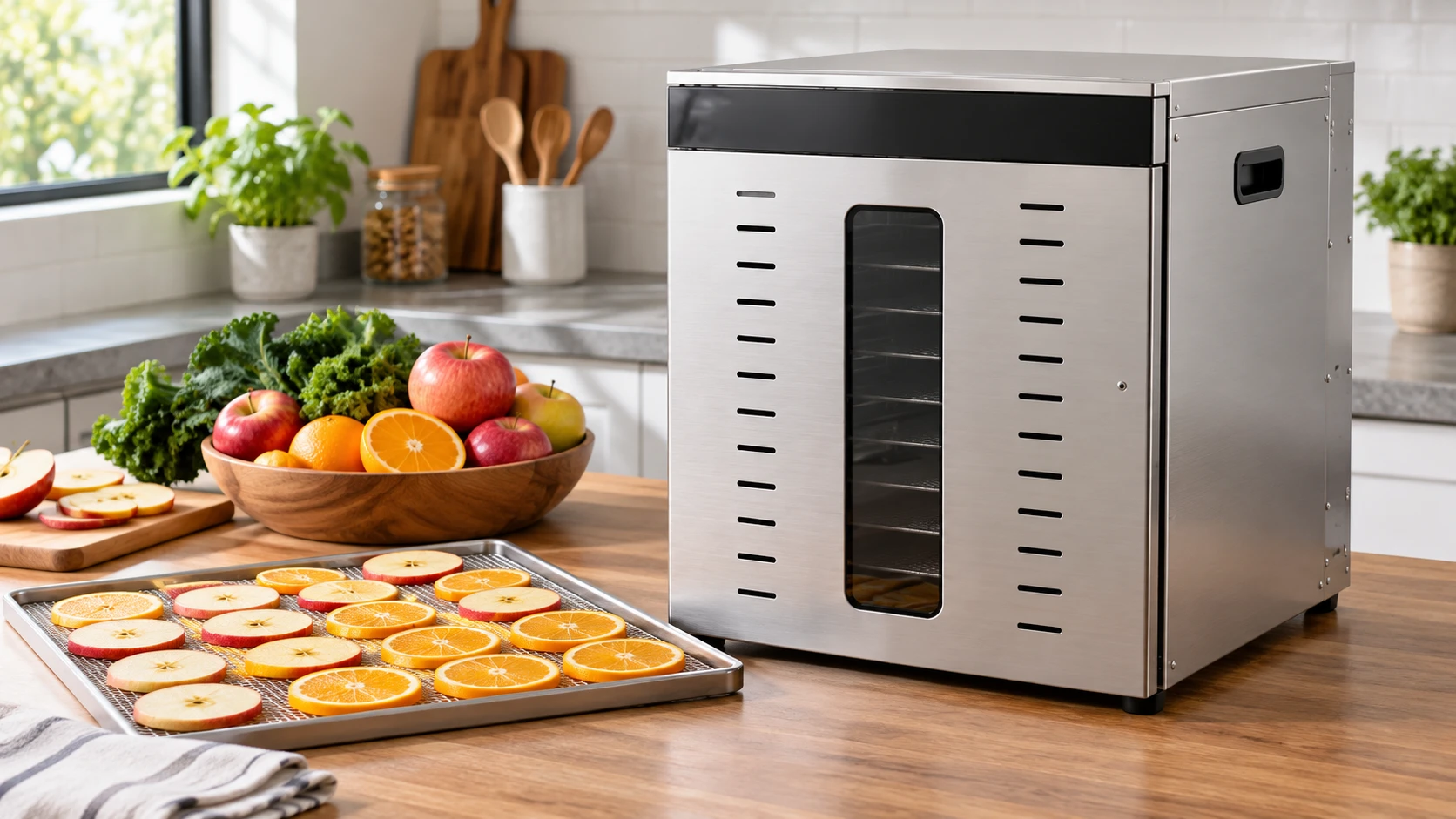
What is a 16-tray fruit and vegetable dryer: how a tray-type food dehydrator works, and why the "number of trays" does not equal output
The 16-tray fruit and vegetable dryer belongs to the food dehydrators in food processing equipment. It adopts a tray-type structure and is suitable for processing scenarios that require batch processing of fruit and vegetable raw materials (product number 1601871037194). Its working method is to spread the fruit and vegetable raw materials on trays, place the trays into the machine layer by layer, and use hot air circulation to carry away moisture and complete dehydration.
Structure and working method of the 16-tray fruit and vegetable dryer: the basic logic of tray-type dehydration
The basic logic of tray-type dehydration is: after the raw materials are loaded onto trays and sent into the machine, hot air circulates between the tray layers, evaporates moisture and discharges humid air, continuing until the target moisture content is reached. The tray here is a carrying unit, not a output unit—the same equipment loaded with apple slices and with whole shiitake mushrooms does not have the same batch feed amount.
Why "16 trays" is only tray-loading capacity, not daily output
"16 trays" describes the number of trays that can be placed inside the machine. It is a structural parameter and is not equal to the single-batch feed weight, nor to the daily processing capacity. Actual capacity is also affected by material form, moisture content, process time, and heat source;Two devices that are both 16-tray may still differ in daily throughput if tray size or operating pace differs. To judge whether it is sufficient, first confirm the load per tray, the process time per batch, and the batches that can be scheduled each day, then convert to daily throughput.
Three steps convert “trays” into daily throughput: load per tray × 16 trays × batch time × loading rate
There is no uniform answer to “how many jin can 16 trays dry at a time,” because the number of trays only determines the placement units; what really determines the load per run is how thick each tray is filled, how high the material moisture content is, and how large the slices are. To turn “trays” into the daily throughput you care about, follow the three steps below, and substitute data confirmed with your own materials or supplier at each step; do not copy other people's numbers.
Step 1: Estimate the load per tray based on material form and moisture content
For the same tray, loading apple slices and loading whole shiitake mushrooms can differ by a large margin in weight. When estimating, first determine three things:
- Slice thickness: the thicker the slices, the more each tray can hold, but internal moisture migration is slower, so batch time will be lengthened; thin slices are the opposite. Thickness should be subordinated to the finished product form you want, rather than accommodating the number of trays the other way around.
- Moisture content: raw materials with high moisture content (such as fresh fruits and vegetables) have a large initial weight and lose weight noticeably after drying; The loading amount per tray should be based onWeight of wet material loaded per trayCalculate by this, and don't treat dry product weight as the loading amount.
- Tray loading method: Single-layer spreading, multi-layer stacking, and whether air channels are left all change the actual loading amount and also affect whether hot air can penetrate.
In practice, take your typical material, spread it evenly across one tray at the planned thickness, weigh the wet weight, and repeat for 2–3 trays and take the average to obtain the "loading amount per tray (jin/tray)." If there are no conditions for actual measurement, make this value the first question to confirm with the supplier.
Step 2 and Step 3: Multiply by 16 trays, divide by the batch time, then correct using the loading rate
Step 2: Loading capacity per tray × 16 = Theoretical loading capacity per batch. Note that this is a "theoretical value"; in actual tray loading, it is difficult to fill every tray completely and keep the thickness consistent.
Step 3: Daily processing capacity ≈ Loading capacity per tray × 16 × Loading rate × (Effective daily drying time ÷ Batch cycle time).
Two of these coefficients are most easily overlooked:
- Loading rate: Affected by material shape, whether gaps need to be left, and tray-changing operations, it usually cannot reach 100%.Use your measured "actual loading weight ÷ theoretical full-load weight" to estimate a conservative value.
- Batch time: jointly determined by thickness, moisture content, target final moisture, and the equipment's temperature control method; it is not a fixed value.Thick slices and high-moisture materials will significantly lengthen the single-batch time, directly reducing daily throughput.
An example to illustrate the conversion logic (the numbers are for demonstration only, not product parameters): if the measured load per tray is 20 jin, the loading rate is 0.8, a single batch takes 8 hours, and effective operation is 16 hours per day, then daily throughput ≈ 20 × 16 × 0.8 × 2 = 512 jin of wet material. Change it to 15 jin per tray and 10 hours per batch, and the result is immediately different—this is exactly why you cannot simply ask "how much can it process in a day."
What you need to confirm with the supplier
- The actual usable dimensions and layer spacing of the trays in this 16-tray model determine the upper limit of your tray-loading thickness;
- The temperature control method and air circulation structure determine whether thick-slice materials can shorten the batch time;
- Whether tray material and tray count configurations can be adjusted to match your materials and loading rate.
Organize the wet weight per tray of your own materials, target thickness, and acceptable batch time, then have the supplier calculate according to your conditions; only then can the resulting daily processing capacity be used for procurement decisions. If your daily processing capacity far exceeds the batch capacity of 16 trays, it indicates that this model is too small, and you should turn to a larger batch or continuous solution instead of forcing it by extending working hours.
Which scenarios are suitable for a 16-tray fruit and vegetable dryer, and which scenarios are not recommended: the boundary between second-grade apples, multi-variety cooperatives, and large-scale continuous production
The capability boundary of a 16-tray tray-type dryer is "batch capacity," not "daily production capacity." It is suitable for a processing rhythm of several batches per day, 16 trays per batch, and varieties and processes that can be switched at any time;It is not suitable for single-variety production lines that require continuous feeding and whose daily processing capacity far exceeds the single-batch loading capacity. To decide whether to buy a tray dryer or a drying room, first look at peak arrival volume and variety change frequency, rather than comparing prices first.
Suitable scenarios: concentrated harvest of second-grade fruit, multiple varieties in small batches, central kitchen ingredient preparation
- Concentrated harvest of second-grade apples and pears: When fresh sales are sluggish, rapid dehydration is needed within a few days to cut losses. The 16-tray batch operation allows drying as goods arrive, without waiting to accumulate enough material for a full room.The prerequisite is to calculate whether the day's peak second-grade fruit volume can be loaded in several batches that same day; if it cannot all be loaded, it will pile up.
- Cooperatives with multiple varieties in small batches: Shiitake mushrooms, carrots, and sweet potatoes are processed in rotation; switching varieties on the same equipment is more flexible than using dedicated lines.The cost is that each variety change requires cleaning trays, adjusting temperature, and running a trial batch; the more frequent the changes, the less effective processing time remains.
- Central kitchen ingredient preparation: Dehydrated vegetables as auxiliary materials, with stable usage but small single batches; tray machines can open batches on demand for better controllability.In such scenarios, temperature control uniformity must be confirmed as a priority; otherwise, fluctuations in color and moisture content between batches will affect batching consistency.
Not recommended scenarios: large-scale continuous production of a single variety with a daily processing volume far exceeding the 16-tray batch capacity
For large-scale continuous production of a single variety with a daily processing volume far exceeding the 16-tray batch capacity, it is not recommended to force it with tray machines. Such requirements are usually better suited to continuous or heat pump drying room solutions; relying on stacking multiple tray machines not only increases floor space and labor costs but also makes batch consistency harder to manage. Compared with natural sun drying, tray machines buy certainty unaffected by weather; whether it is worth it depends on loss risk and delivery requirements;if it is only for a small amount of self-use and there is no time pressure, sun drying or outsourcing processing is still acceptable.
Next, organize the daily peak processing volume, number of main varieties, variety change frequency, and site conditions, and check with the Nanyang team whether the single-batch loading and batching rhythm can cover the peak. If this step isn't calculated clearly, buying a tray machine or a drying room is just guesswork.
List of parameters and acceptance points that must be confirmed with Nanyang before purchase: tray size, temperature control method, voltage, cleaning requirements, and safety markings.
16 trays is a structural description, not a capacity commitment. Even when labeled "16 trays," differences in tray length and width and layer spacing mean the loading capacity per batch will vary. It is recommended to confirm the following list item by item in writing with the Nanyang team before discussing price and delivery time.
Key parameters to confirm with the supplier: tray size, layer spacing, temperature control method, voltage, and cleaning requirements.
- Tray size and layer spacing: Ask for the effective spreading dimensions of a single tray, the tray spacing, and the total layer height.This determines whether your result is realistic when you convert the daily processing capacity based on "how many jin of fresh material are loaded per tray."If the layer spacing is too small, thick material cannot be spread out and the airflow path is poor.Also confirm the tray material and whether trays can be purchased separately, as trays are long-term consumable parts.
- Temperature control method and temperature measurement location: Confirm whether it is mechanical or digital display, the sensor installation location, the temperature control range, and whether there is over-temperature protection.Do not just ask "can the temperature be adjusted"; ask "how much difference is there between the displayed temperature and the actual material temperature, and how is it calibrated?"Temperature control deviation is a common source of quality fluctuation and high power consumption.
- Voltage and incoming line conditions: Confirm the rated voltage, number of phases, total power, and starting current against the site's incoming power capacity.A voltage mismatch may require a capacity upgrade, and this cost should be included in the budget in advance.
- Cleaning requirements: Find out clearly whether the inner liner, trays, and air ducts are removable for cleaning, whether there are hard-to-clean corners, and whether the materials are resistant to washing.When rotating multiple product varieties, cleaning labor hours are a hidden cost.
Acceptance and after-sales: How to negotiate safety markings, electrical protection, spare parts supply, and warranty terms
Safety markings and electrical protection must be put in writing: require the provision of nameplate information, grounding and leakage protection configuration, and protection rating documentation;If markings are missing or the documentation is vague, do not let it pass based on "it should be fine."
Incoming inspection is done in three steps: check whether the nameplate matches the contract parameters;run the machine without load to observe heating rate, temperature control stability, and fan operation;run a trial batch with material and record the actual time required and the uniformity of the finished product. After-sales terms must clearly state the warranty period and scope, the supply cycle and unit price of wear parts (trays, sensors, heating elements), whether repairs are on-site or return-to-factory, and the response time limit. For OEM/private-label customization, separately confirm the minimum order quantity, who bears the cost of appearance and packaging changes, who is responsible for consistency between the manual and the nameplate, and whether the delivery time will be extended.
In terms of budget, prioritize core configurations such as capacity matching and temperature control method, and defer non-core items such as tray material and custom appearance.
Frequently Asked Questions
What should I do if the temperature control display does not match the actual material temperature? First confirm the sensor location and calibration method; during trial operation, compare and record with an independent thermometer as the basis for acceptance.
What is the approximate energy consumption of a 16-tray machine? It is related to total power, insulation structure, and usage duration. Please have Nanyang provide an operating power description based on your voltage and process, then estimate in combination with local electricity prices.
Can it be private-labeled? It can be discussed, but the minimum order quantity, redesign costs, and impact on delivery time must first be confirmed before deciding whether to include it in the channel plan.
How should we proceed to the next step? Supplement the material form, daily processing volume, and site power information, and the Nanyang (Henan Ruichisi) team will assist in confirming a matching solution.
Learn more
If you are evaluating whether a 16-tray fruit and vegetable dryer matches your materials and production capacity, you can organize the material form, wet weight per tray, target thickness, daily peak processing volume, and on-site power conditions, and submit them to the Henan Ruiqisi team. We will help calculate the single-batch loading and batch rhythm according to your working conditions and provide practical selection recommendations.