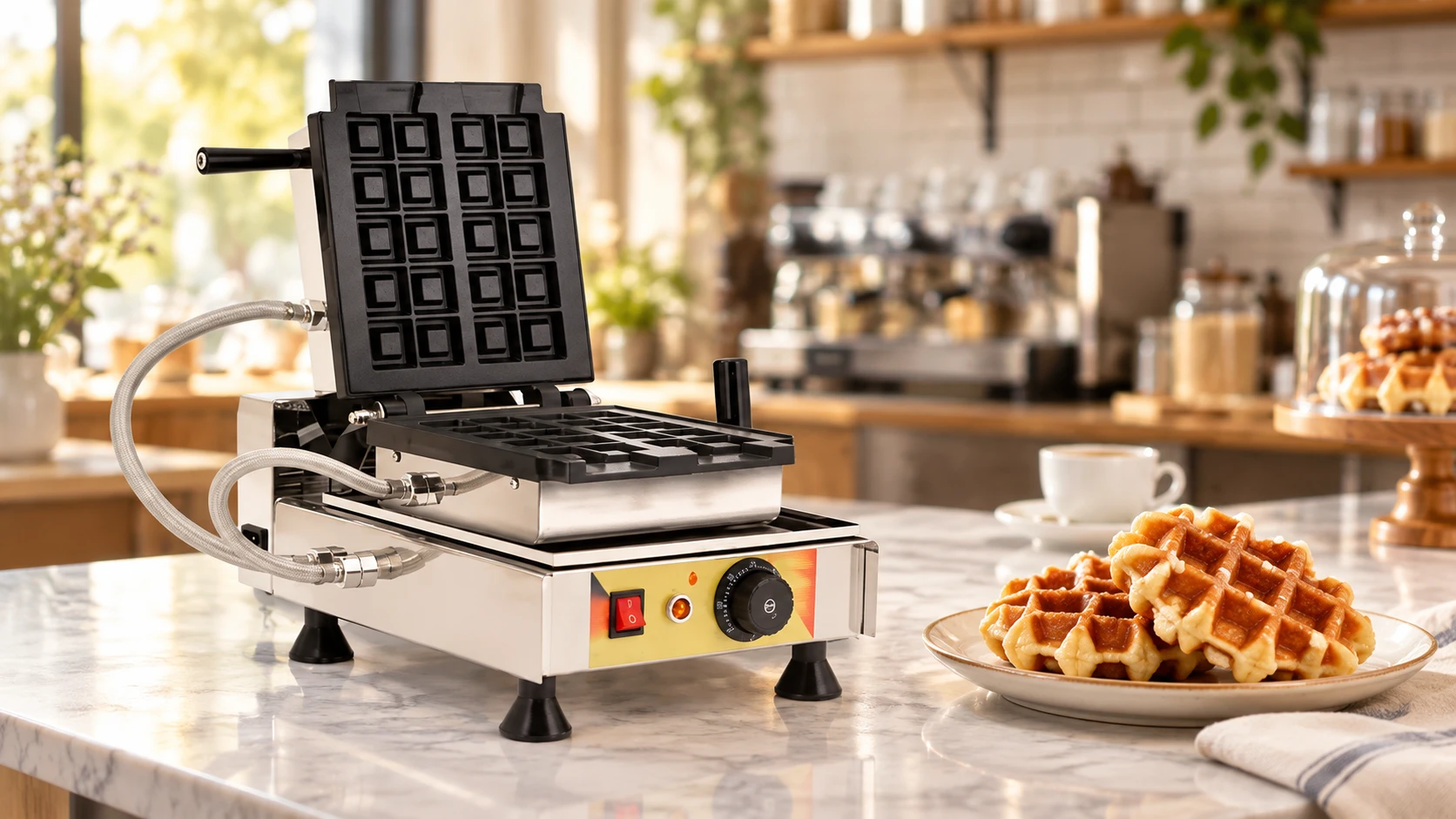
What a Liège waffle maker is: its first layer of difference from an ordinary waffle iron lies in the baking plates and the dough
The most common pitfall when purchasing is treating "waffle maker" as a single unified category for price comparison. Liège waffle makers and ordinary waffle irons do both produce grid-patterned cakes in finished form, but their baking plate structures and compatible doughs are fundamentally different from the ground up; choosing by mixing them will directly lead to product failure or capacity mismatch.
Baking plate structure and dough type: why a Liège waffle maker cannot simply copy the recipes of an ordinary waffle iron
Ordinary waffle irons correspond to batter-type recipes: thin, flowable, naturally filling the grid cavities after the upper and lower molds close; the baking plates are usually shallower with regular grid patterns, aiming for thin, crisp or soft, flat cake bodies. Liège waffle makers correspond to dough-type recipes, requiring a baking plate structure that can support thicker dough, accommodate expansion, and form deeper grid patterns and thick cake bodies. Pouring thin batter into baking plates designed for dough results in incorrect spreading and setting;Conversely, putting fermented dough into a shallow-grid batter iron leaves insufficient room for expansion, and the product likewise fails.
So when judging whether a machine is suitable for you, the first question is not "how many grids, how much power," but:Do you plan to use batter or dough? If this layer isn't settled, all subsequent parameter comparisons lose their meaning.
Basic positioning of the Nanyang Liège waffle maker: commercial on-site baking equipment under the food processing equipment category
The Nanyang Liège waffle maker is classified in the product system under the food processing equipment category (category 927783013), positioned as equipment for food ingredient processing, handling, or commercial catering production, rather than a household small appliance. This positioning means the selection logic is closer to production equipment procurement: first confirm the process (dough specifications, output per batch, continuous serving rhythm), then discuss configuration;The stainless steel structure or components mentioned in public information also need to be confirmed against your actual usage intensity to see whether they match.
For buyers and engineering project procurement, this means two things: first, installation, cleaning, and maintenance conditions must be checked against the standards for "equipment" rather than "utensils";Second, front-end conditions such as the dough formula, the weight of a single piece, and the fermentation process must be confirmed together with the equipment parameters; you cannot wait until the equipment arrives at the store to test them.
What should be confirmed next
Before moving on to parameters such as the number of slots, power, and dimensions, first write these three conditions clearly, then check the matching solution with the Nanyang team:
- Dough type and weight per piece: determines the depth of the baking tray cavities and the specifications of a single batch of output;
- Output rhythm: whether it is continuous serving during peak hours or low-frequency fresh baking determines the heat recovery requirements and equipment configuration;
- Source of the existing formulaWhether it is your own dough or purchased semi-finished products affects the difficulty of subsequent training and standardization.
If these three items are not decided, any judgment about whether production capacity is sufficient is just guesswork.
Product form and continuous output capability: the second layer of differences determines which type you should buy when opening a store.
The first layer of differences determines whether it can be done; the second layer of differences determines whether it can withstand the peak.
Product form and texture characteristics of the Liège waffle maker: why it is more suitable for freshly baked SKUs.
The value of the Liège waffle maker lies in its product form being suitable for freshly baked and freshly sold items: the dough is relatively thick, and after baking it is crispy on the outside and soft on the inside. The finished product is more suitable for handheld immediate consumption or bagged takeaway, and it is also convenient as a base for added toppings. This type of form is suitable for placement at the bar counter or a street-facing window for visible freshly baked production, rather than batch pre-baking and reheating in the back kitchen. When purchasing, it is necessary to confirm whether the baking plate shape and temperature control method of the specific model can stably reproduce the target finished product form. It is recommended to confirm the relevant configurations with the Nanyang team.
Continuous production during peak hours: how to judge thermal recovery and color consistency
If the color of the later batches becomes lighter and the speed slows down, it is usually the combined result of thermal recovery capacity and operating pace. On the equipment side, check whether the baking pan's heat storage and heating power can sustain continuous mold opening and closing;on the operation side, it is related to dough temperature, loading amount per batch, and mold opening frequency. Judgment method: use the same batch of dough and the same gram weight to make 5–8 consecutive batches, and record the time and color of each batch. If the first two batches are normal but later ones show obvious degradation, first check the loading amount and dough temperature, then confirm whether the equipment's thermal recovery matches the peak pace.
| Judgment dimension | What to look at | Explanation |
|---|---|---|
| Output per batch | 2 units per batch, 4×6 grid | Estimate output per oven based on validated parameters |
| Dough specifications | 125–130 g per piece | Finished product approximately 115 g, daily sales volume can be back-calculated |
| Continuous performance | Heat recovery and browning consistency | Depends on specific operating conditions; temperature control details need to be confirmed with the supplier. |
How many can be produced at a time and how daily sales are calculated can be estimated by combining the above parameters with the store's peak order volume;Continuous output performance depends on specific operating conditions. It is recommended to provide the Nanyang team with the estimated peak order volume, dough weight, and menu structure, and to work backward to daily capacity after confirming the machine model's cavity count and temperature control plan.
Which scenarios are suitable for Liege waffle makers and which are not recommended: selection boundaries based on store area and customer flow
To determine whether a Liege waffle maker should be brought into a store, first look at two boundaries:Whether the store area matches the equipment footprint、Whether the customer flow frequency matches the quantity produced per batch. Liege waffle makers are food processing equipment, and their core value is fresh baking, hot output, and standardization, making them suitable for stores that incorporate fresh baking into their menu structure.
Scenarios suitable for the above-listed Rihua waffle makers: specialty coffee shops, dessert shops, central kitchens + in-store baking
- Specialty coffee shops: menus need to add freshly baked SKUs, store space is small, and staff are few; when selecting models, prioritize confirming machine dimensions, output per batch, and cleaning steps rather than pursuing maximum capacity.
- Dessert shops/bakery stores: foot traffic is concentrated in the afternoon and on weekends, requiring fast heat recovery and consistent browning;during procurement, confirm with the supplier the recovery performance and operating intervals during continuous operation.
- Central kitchen + in-store baking: the central kitchen standardizes dough specifications and semi-finished product standards, and stores are only responsible for baking;Output consistency depends on whether dough weight, proofing state, and baking parameters are fixed; equipment is only one part of it.Stores should size equipment based on peak customer flow, not average daily customer flow.
- Hotel breakfast/banquet tea breaks, pastry studios: Short-term concentrated output or small-batch multi-variety production requires a balance among capacity, cleaning and maintenance, and output standardization.
Scenarios not recommended or requiring caution: small-area low-traffic stores, stores without fresh-baking demand
- Small stores of just over ten square meters with low customer flow: The main risk is not excess capacity, but the high per-serving cost of preheating, cleaning, and employee learning, making it difficult for fresh-baked categories to form stable repeat purchases.If fresh-baked waffles are only meant to make the menu "look rich," it is not recommended to add them;If it is the main traffic-driving offering and can produce stable output, choose a configuration that is simple to operate and easy to clean, rather than a high-capacity model.
- Stores with no on-site baking needs: Those that only do pre-packaging or reheat finished products purchased externally will find it hard to turn equipment investment into a differentiated experience, so it is not recommended to adopt.
- Insufficient counter space and unaffordable staff training costs: First confirm the workflow and staffing conditions, then decide whether to purchase.
Next steps to confirm: Provide the Nanyang team with three pieces of information—store area, estimated output portions during peak hours, and whether central-kitchen semi-finished products are used—and ask them to give recommendations on matching specifications and configurations based on actual usage conditions;For items not listed in public materials, such as continuous output capability and cleaning and maintenance methods, confirm them together before allocating the budget.
How to confirm compatibility before purchasing: a decision checklist for specifications, operation, and cleaning and maintenance
Whether a Liège waffle maker is worth investing in depends on whether the store can use it consistently. Before purchasing, confirming the following items clearly is more useful than comparing promotional pages.
4 items that must be confirmed before purchasing: baking plate shape, equipment dimensions, temperature control, and operating requirements
- Baking plate shape and number of grids: It is necessary to confirm the baking plate shape, number of grids (such as 4×6 grids), and the amount of dough that can be placed at one time, as this directly determines menu pricing and packaging matching.What baking plate specifications and configurations Nanyang can provide must be confirmed item by item with the supplier.
- Equipment dimensions and counter space: Measure the available width of the counter, check whether there are wall cabinets above, note the power outlet locations, and confirm the lid opening direction and whether you can reach inside for maintenance.
- Temperature control method and operating requirements: Confirm the temperature adjustment method, preheat time, and whether there is a timer or alert.For stores with few staff and concentrated peak hours, the shorter and more consistent the operating steps, the better.
- Ease of cleaning and maintenance: Ask clearly whether the grill plate is removable, roughly how much time daily cleaning takes, and whether special tools are required.For stores with tight pre-opening preparation time, if cleaning takes more than half an hour before opening, it will squeeze the stocking schedule.
Cleaning, maintenance, and employee training costs: easily underestimated selection factors
Stainless steel structures or components (according to public titles) are reference points for cleaning and maintenance, but you cannot just look at the three words "stainless steel." You need to confirm with Nanyang which parts are stainless steel, the material description of food-contact surfaces, and the types of compliance documents that can be provided. Without this information, do not draw compliance conclusions on your own.
Employee training costs must also be factored in: new equipment means new dough specifications, baking times, and output standards. In stores with high staff turnover, the simpler the operation and the fewer the standards, the less likely output will fluctuate.
Decision boundary: when the goal is clear and the scenario matches, choose the Liège model;when the goal is unclear or customer traffic is extremely low, choosing a simpler solution is more cost-effective.
Next stepsProvide Nanyang with operating condition information such as store area, foot traffic, and menu structure, and the team will assist in confirming a matching solution. For inquiries, you can reference product number 1600825681074 and category 927783013;Capacity, certification, delivery time, or warranty data are subject to supplier confirmation, and this article makes no commitments.
Frequently Asked Questions
Will cleaning affect preparation for opening? It depends on the grill plate structure and daily usage volume. Before purchasing, ask the supplier to explain the cleaning method and approximate time required, then judge against your opening preparation schedule.
Does a stainless steel structure mean compliance? Not equal. The food-contact surface materials and related documents need to be confirmed; a conclusion cannot be drawn based on the structural description alone.
Do you support OEM and customization? Specifications, configurations, and OEM arrangements need to be confirmed item by item with Nanyang; different configurations may correspond to different baking plates and operating methods.
Will listing the Rihua waffle maker in a small shop cause overcapacity? The key depends on customer traffic and menu structure. If it is only a low-frequency supplementary category, first assess whether the cleaning and training costs are worth it.
Learn more
If you are selecting a Liège waffle maker for a store or project, you can organize the store area, the number of servings produced during peak hours, the dough type and weight per piece, and the source of your existing recipe, and hand them to the Nanyang team. Based on this, we will help verify the baking plate specifications, machine model and cavity count, and temperature control configuration, and provide a solution that matches your actual operating conditions.